

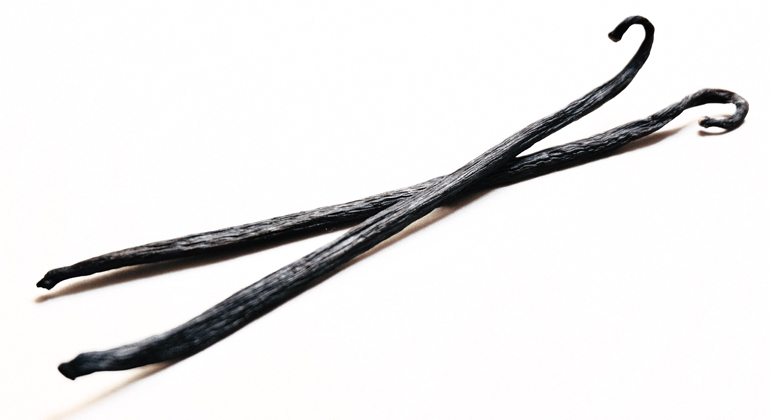
The Bourbon vanilla pod (Madagascar, Comoros and Reunion) is distinguished by its taste of vanilla and fruit, velvety and creamy on the palate and its rich and round smell. Intoxicating and exotic, the dried pod presents a complex palette of aromatic notes: powdery, sweet and honeyed, cocoa and almond, balsamy and woody, smoky, animal and spicy, rumy and oily…
It should be remembered that when harvested, the green vanilla pods do not exude any fragrance, containing only the precursors of the final aroma. The pods will undergo a series of treatments which will allow the release of the aroma.
The first important step in the process is scalding, which consists of immersing the green pods in hot water at 65/70°C, for 3 to 5 minutes depending on the maturity of the pod. The aim of this operation is the vegetative arrest of the pod.
The next step is steaming. After scalding, the pods are drained and placed in padded wooden boxes, boxes covered with blankets to avoid temperature loss. The conditions of hygrometry, temperature and oxygenation are met so that under the action of the enzymes naturally present in the pod a series of enzymatic reactions are triggered, developing the aromatic principles of the pod, namely vanillin and associated phenols. , but also many aromatic compounds in traces, but with a strong influence on the quality of the aroma.
Alongside the well-known aromatic compounds, vanilla, 4 hydroxybenzaldehyde and their corresponding acids, complex tannins, sugars, other minor compounds occurring at a rate of a few tens of milligrams per kg of pods and having a significant action on the perception of the velvety and creamy note of the pod have been identified. These molecules are dimers formed from vanillin and other phenols present, under the action of enzymatic oxidative coupling reactions.
These dimers at concentrations from 5 to 50 ppm in dairy products have demonstrated their ability to increase creaminess and sweetness, thus contributing to the organoleptic improvement of the commodity. These thresholds are identical to the quantity of these dimers present in the vanilla pod. Vanilla extracts in ice cream or yogurt have a pod equivalent of a few grams per kg. It is therefore obvious that to benefit from the taste improvement brought by these dimers, it is necessary to increase their quantity initially present in the pod having undergone traditional treatment.
Laboratory tests have shown the possibility of producing oxidative couplings from vanillin and phenols or related molecules under the action of lipoxygenases or oxidoreductase. The transposition of these reactions on pods, which will be the sources of vanillin and various phenols, should make it possible to produce extracts naturally enriched in dimers. Keeping the name, pure vanilla extract.


Leave a Comment