

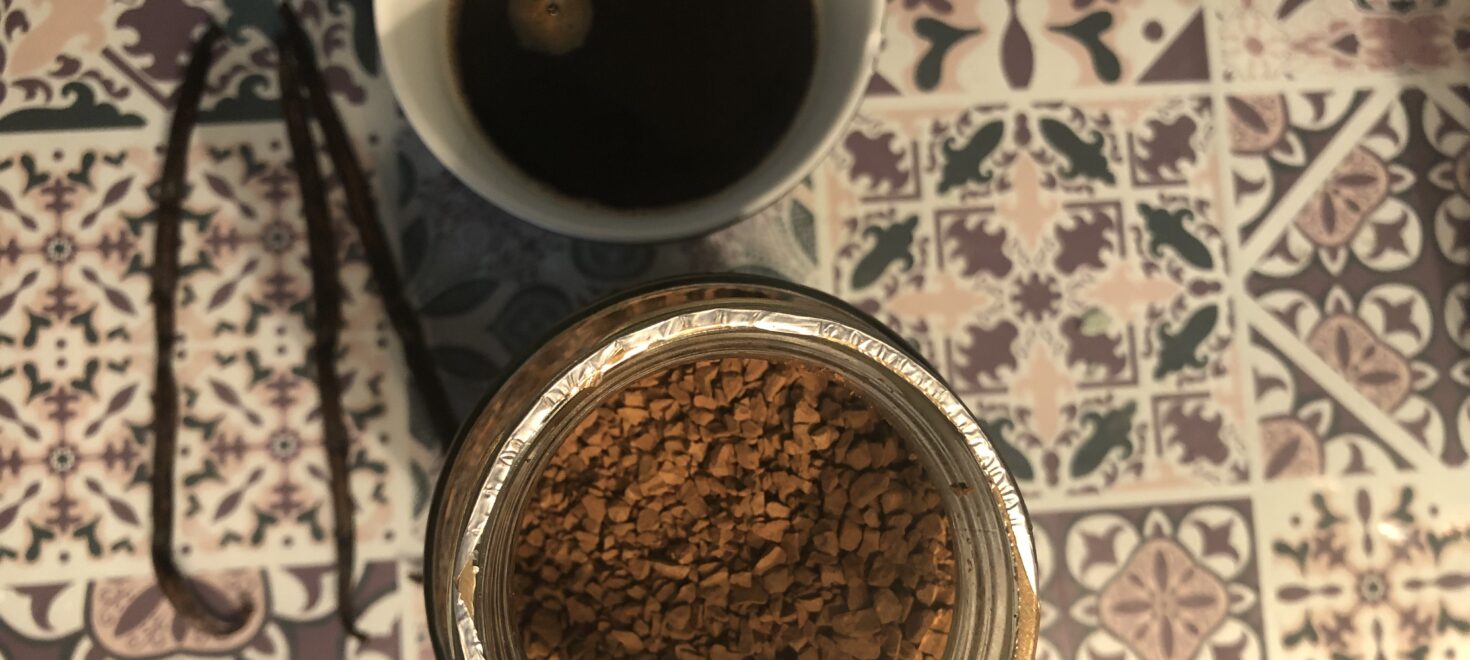
Breathing the headspace above a jar of “Carte Noire” soluble coffee is a unique olfactory experience that results in an explosion of incomparable aromatic notes. I will guide you to the heart of this whirlwind of smells by detailing the different olfactory sensations perceived and trying to explain them by linking them to an Arabica coffee aroma formula. The selected coffee flavor was developed by me, based on analytical and sensory studies of an Arabica espresso coffee. The concentrations indicated for each molecule are those present in one liter of water, after adding the aroma at the optimal dosage.Naturally the first note detected is the characteristic, sulfurous note of roasted coffee. It is due to 2-furfurylthiol, formed during roasting, via a Maillard reaction between hydrogen sulphide, released by cysteine and 2-furfural produced by a sugar, arabinose (56 µg, perception threshold <0.1 µg/L).
A milky, creamy note then appears, contributing to an impression of breakfast, coffee with milk or milk chocolate. It is explained by the combined presence of diacetyl (500 µg, threshold of perception 5 µg/L), 2,3-pentanedione (300 µg, threshold of perception 30 µg/L) and butyric acids (300 µg, threshold of perception 35 µg/L) and 2-methylbutyric (400 µg, perception threshold 110 µg/L) in interaction with the previous coffee and chocolate aromas.
Vanillin is naturally present in coffee. It comes from the degradation of chlorogenic acid. Combined with the following phenols, guaiacol (110µg, perception threshold 2.5 µg/L), p cresol (1.8 µg) and eugenol, it helps to create a note of dried vanilla pod. Other phenols like 4-vinyl guaiacol and 4-vinylphenol, absent in my flavor, have been identified in both coffee and vanilla bean.
Other warm notes with a positive hedonic impact are also identifiable, namely the flavor of burnt caramel, the smell of biscuit hazelnut and the olfactory impression of maple syrup. They are respectively provided by furaneol (700 µg, perception threshold 13 µg/L), futfural (600 µg) and furfuryl acetate (100 µg) for caramel, 2-acetylthiazole (4 µg) and various alkylpyrazines, resulting from roasting, for the biscuity hazelnut component, sotolon (0.6 µg) with the characteristic fenugreek odor and methylcyclopentenolone (750 µg) for the maple note.
Alongside these warm notes, at the origin of olfactory impressions felt positively, there are other odors perceived rather negatively. I am thinking in particular of a fatty meaty note due to the association of 2-methyl furan-3-thiol (1 µg, perception threshold 0.007 µg/L) with the smell of boiled beef and methional (4 µg, threshold of perception 0.27 µg/L) with potato typicality.
The smell of cold tobacco is also perceptible. It is due to the presence of pyridines in coffee and more particularly 3-ethylpyridine (40µg) and pyrazines, notably methylpyrazine (200µg). These 2 molecules, by interacting with the phenols mentioned above, generate this sensation of cold tobacco.


Leave a Comment